We left Kumai with the idea of a nice sail to Bali with maybe rest stops at Bawean and Kangean before tackling the currents in the strait. The Indian Ocean floods into the Java Sea through just a few small openings between the Islands in the Indonesian archipelago. The currents are intense and they can stop your boat dead in its tracks, even sending it backwards if you sail against the flood. Planning is required.
Before we even had to face that, a cyclone had formed in the Indian Ocean, drawing the winds in the Java Sea into it. The first of many daily squalls hit us just after leaving the Kumai river delta. The squalls were vicious, whipping the sea up and making life a little bit miserable. As we continued south, it got worse. On the third day the seas were up over 4 meters and the winds were hitting 40+ in the gusts. No fun at all.
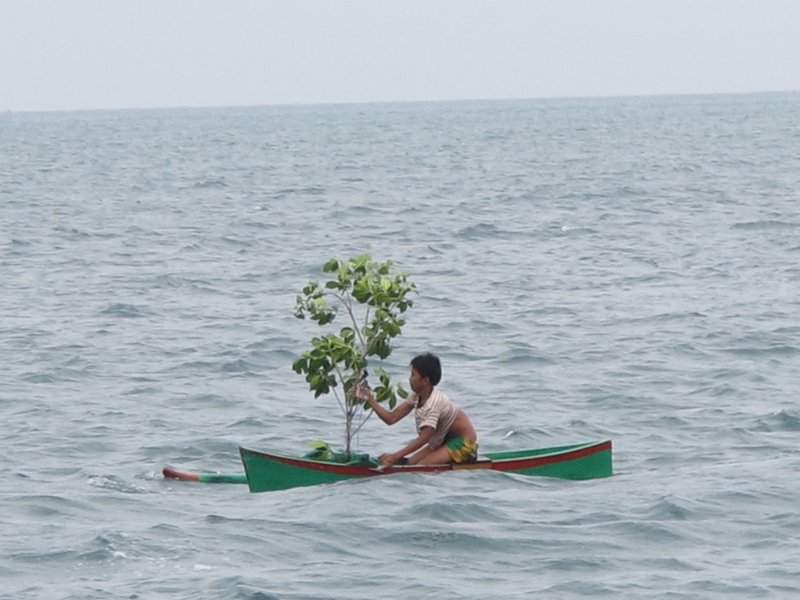
We had to get out of it so we pulled in on the morning of the 4th day into the lee of Kangean Island. Soon we were joined by several local fishing boats and behind us, farther out, were two tugs and their barges seeking shelter from the high seas. We would be stuck there for 6 days waiting for a good weather window to get the rest of the way to Bali. In the meantime, we watched the local activity as the weather improved, including these guys sailing across the bay using leafy branches as sails. Never saw this before. And we read a lot and baked. Something about fresh cinnamon rolls when you're holed up........
Against our better judgement we pulled out of Kangean in the morning to sail to Bali, which would make a night arrival off the coast of the island. Besides missing the absolutely awesome view of the volcanoes from the sea, we had to deal with UFO's (Unidentified floating objects) in the pitch dark. At one point we missed by a centimetre a large, rickety platform used by the fishermen. Then as the wee hours of the morning approached, hundreds (no exaggeration) of small fishing outriggers left the shore in the dark under sail, no sound, we could only see them from a few feet off and they made little attempt to avoid our boat. It was like being in a pong game. We had a little fun calling out Selamat pagee (good morning) to them as they passed. Sometimes we would get a "yo" back. Wish I had a picture of them.
We attempted to get all the way to Bali Marina in Benoa at the bottom of the island but we hit the current about 20 miles short of our goal and went down to .3 miles per hour. So we turned back to a small bay behind us, now making 10 knots with the current. It took us 20 minutes to go back over the ground we had sailed in 2 hours. We anchored next to a workboat off a resort and just enjoyed watching tourists on their snorkeling excursions. In the morning we tried it again, this time going farther offshore, towards Nusa Lembongan, but still hit nearly a wall with the current. The rips were everywhere and we were pretty sure we were in the right spot as there were local vessels also heading south with us.
Eventually we made it in to Benoa and headed for the Bali Marina. This is a poorly maintained, small marina but the only game in town, and as we wanted to make a couple of trips off the boat, we had no choice but to go in here (Jim won't leave the boat unattended at anchor). We were looking forward to a meal out and some ice cream when the dock hands informed us that the next day we could go nowhere, only stay on the boat and be quiet. It was the celebration of Nyepi, a Hindu practice for their New Year and involves a day of meditation without the influences of the outside world. Bali is the only place in Indonesia that actually practices this to such an extent that everything shuts down for the day and usually starts the day before. ATM machines were even unplugged, no cars operated, no stores, restaurants, businesses were open, electricity was to be used only sparingly so most of the lights were turned off. Even the airlines were forbidden to operate in Bali on this day. Believe me it was very quiet here.
We arranged then to take a car up to Kintimani to view the volcano and its crater lake. Then we took a boat ride across the lake to the village of Terunyon and a burial site where the bodies are placed in baskets above ground in a crude cemetery. The bones are later stacked up nearby. The boat ride was ridiculously expensive. It was an obviously corrupt business as the rates were clearly posted at the ticket window, but a tout waylaid us and wanted $75 to make the 20 minute journey. I'm sure the ticket taker would get a cut out of this deal as well. We balked and then I pointed to the window and the rates, so he finally came back and halved the rate. Still way too expensive but we wanted to go.
Then we stopped in Ubud for a couple of days. Ubud is known for its arts, yoga, and local culture. Besides that it is a real touristy town with a million shops and restaurants. It has a nice feel, though. We stayed at the Pradha homestay which was a very nice spot across from the Lotus Pond temple.
There are temples, statues, carvings everywhere in Ubud. And lots of souvenirs to buy if you have a mind for that (or the pocket).
We took in a dance performance at the Lotus Pond Temple. The performers were mostly young girls and the gamelan orchestra was made up of seasoned musicians. Jim thinks the gamelan music sounds like a bunch of wind chimes. I like it.
All throughout the day, the Balinese would make offerings at their little temples, which were everywhere. Some of the private homes or businesses have several temples on the property. And as you walk along the street, you avoid the small leaf trays containing flower petals which are laid in front of doorways.
And, as usual, we made some new friends. These girls wanted to approach us, but were kind of shy about it, so we made the initial contact.
Thursday, April 5, 2012
Kumai River Trip
This trip has been something we've been looking forward to for a long time. We've heard from other cruisers that this was a highlight of the trips through Indonesia. I just love the orangutans and we've seen them before at a few sanctuaries in Borneo, however, we've never had a really close up experience with them. At Camp Leakey, you just can't help getting close to them, they are all around you. It was exciting to say the least.
Before our anchor hit the mud, we were approached by several little speedboats each with guys offering to take us up the river on their Kloktok. We knew that Harry Rosterman came highly recommended from several sources, so we looked him up and he definitely knew his stuff. He was full of information, friendly and helpful, and we had our plan working in just one day.
Here comes our kloktok, right on schedule. Our crew was great. Fardi was our guide and he couldn't have been more gracious and helpful. He was well trained and could answer almost any question we had about the orangutans, the river, or the jungle environment.
Although our little boat was pretty basic, everything was confortable and the crew set everything up for us.
.We had delicious Indonesian meals served to us by our cook, who deserves some kind of medal for cooking on her knees in such a small place. And she was usually singing as she did her chores. Great lady.
This is our captain, Yaya.
It took 5 hours to go up the river, which was a little uneventful except our captain spotted a crocodile along the river bank and backed up to show us.
Fortunately for us not only did we have great weather on this trip, but there were relatively few tourists. We maybe had 10 other people at the feeding stations with us, and just a handful of kloktocs tied up at the docks whereas during the higher season in the summer, the river would be jammed with these boats and maybe up to 100 people at the feeding stations. When we got farther up the river, the brown river water turned to black just like that.
We arrived at Camp Leakey at mid day and in time for the 3 p.m. feeding. Boy, a gibbon, was hanging around the dock getting snacks from the cook. He especially liked pineapple and when our cook gave us a snack of pineapple he swung up onto the boat and on our table to steal some.
We started on down the boardwalk to the camp when there was a loud commotion right behind us on the dock. The king orangutan, or dominant male, Tom, had arrived and the boat hands hustled to move the boats off the dock. If Tom got on to a boat, it would be a big deal to try and get him off before he swiped some souvenirs. Jim and I were a little concerned as he loped along behind us until Fardi explained that the orangutans don't move all that fast on the ground. And Tom seemed unphased by our presence, although you wouldn't want to get up close and personal with this guy. He's enormous.
Tom followed us all the way to the camp where he pestered the rangers for some food. I don't think anybody turns Tom down when he wants something. After his snack of milk and rice, he posed for pictures, and then shared some of his food with other orangutans.
We were lucky enough to see not only Tom, the dominant male, but the dominant female as well, and many babies. When one orangutan is on the platform and another more dominant one arrives the lesser orangutan skedaddles. We watched as the queen bode her time just a few meters away from the platform, and then when she was good and ready she boarded and everyone else scattered into the trees. We sat and watched as they satiated themselves with loads of bananas that the park rangers hike into the woods for them. We could see the mothers training their babies to get from one tree to another. One little guy gave a loud squeak when he wasn't too sure of what to do and his mother turned back, swung her arm out and made a bridge for the little guy.
That was a pretty successful first day.
At night our mosquito net went up, our bed was laid out, and we parked quietly along the river bank, falling asleep to the sounds of the jungle and waking up to the calls of the gibbons in the trees. In the morning the "anchor" was raised (a tire thrown into the weeds - very effective) and we went back to Camp Leakey to check on the orangutans, who by now were our very good friends.....well, maybe not friends exactly...
Our second morning at the camp was just as exciting as the first. One of the queens came by for a visit, eating some fruit she picked herself, then just lolling about for the day. She amused herself by covering herself with branches and then rearranging the whole affair over and over again.
What a life!!!
Later we net Ursula, a precocious young lady. At six she is really supposed to be on her own, but she still hangs out with mom and whenever mom moved along, Ursula would put her hand on mom and go with her. Ursula had a sibling she seemed to be much taken with and played with it in between chasing games with Fardi who teased her with bananas hidden in a pocket.
The rangers live a kind of lonely life out there. Here a young ranger cooks in his kitchen. No modern conveniences here!!
There were 3 feeding stations that we visited all together. On the last trail one big orangutan was hanging off a tree right on the trail, waiting for the rangers to bring the bananas. On each trail we were accompanied by the orangutans as they made their way to the feeding stations for their daily treat.
So enough of the orangutans, already. I've got a million pictures of them, but I'll spare you. In addition to them there were the ubiquitous macaques, my least favorite monkey ever since I watched a pack of them terrorize a puppy in India. While focused on the orangutans, we had a visit from a herd of wild piglets.
These are pitcher plants, just waiting to lure in an insect for a drink.
We visited a reforestation project. Several years ago the park was in danger of obliteration from a devastating forest fire. We could make a small contribution by purchasing a sapling and planting it for the future growth of the forest.
And, on our way out of the jungle we visited the village of Sekonyer, built along the river. The folks here have to move every once in a while as it floods along here regularly. We were there at the end of the day and families were together on their porches while children were playing and washing in the canal.
And last, we watched elderly craftsmen and women ply their trade, which they have probably done for their whole lives. A man weaves a fish trap and a husband/wife team make leaf panels for roofing.
Cruiser notes: Anchor just right of the center of the river. You will most likely see ships and tugs/barges anchored as well. Harry's office is just to the right (from the river) of the ferry dock and we were anchored across from his office. The trip was more expensive than I thought it would be. We did the 3 day trip and we paid $430 for it. You can for slightly less do the 2 day trip in which you see the same things as we did only you don't spend the day at Camp Leakey. You would have a small chance, then, that you won't see any orangutans at all. You can get fuel and laundry done also through Harry or any of the other speedie boats that come by wanting your business. They charge a lot for fuel, 8,500 Rph when it is 4,500 Rph at the station. We went to Pangalan Bun town via bemo. The grocery store leaves a lot to be desired but there was a nice coffee house on one of the side streets with good shakes and coffee drinks. Not a lot in Kumai town itself, however there is a market but you need to get there early. They close up by mid day.
Before our anchor hit the mud, we were approached by several little speedboats each with guys offering to take us up the river on their Kloktok. We knew that Harry Rosterman came highly recommended from several sources, so we looked him up and he definitely knew his stuff. He was full of information, friendly and helpful, and we had our plan working in just one day.
Here comes our kloktok, right on schedule. Our crew was great. Fardi was our guide and he couldn't have been more gracious and helpful. He was well trained and could answer almost any question we had about the orangutans, the river, or the jungle environment.
Although our little boat was pretty basic, everything was confortable and the crew set everything up for us.
.We had delicious Indonesian meals served to us by our cook, who deserves some kind of medal for cooking on her knees in such a small place. And she was usually singing as she did her chores. Great lady.
This is our captain, Yaya.
It took 5 hours to go up the river, which was a little uneventful except our captain spotted a crocodile along the river bank and backed up to show us.
Fortunately for us not only did we have great weather on this trip, but there were relatively few tourists. We maybe had 10 other people at the feeding stations with us, and just a handful of kloktocs tied up at the docks whereas during the higher season in the summer, the river would be jammed with these boats and maybe up to 100 people at the feeding stations. When we got farther up the river, the brown river water turned to black just like that.
We arrived at Camp Leakey at mid day and in time for the 3 p.m. feeding. Boy, a gibbon, was hanging around the dock getting snacks from the cook. He especially liked pineapple and when our cook gave us a snack of pineapple he swung up onto the boat and on our table to steal some.
We started on down the boardwalk to the camp when there was a loud commotion right behind us on the dock. The king orangutan, or dominant male, Tom, had arrived and the boat hands hustled to move the boats off the dock. If Tom got on to a boat, it would be a big deal to try and get him off before he swiped some souvenirs. Jim and I were a little concerned as he loped along behind us until Fardi explained that the orangutans don't move all that fast on the ground. And Tom seemed unphased by our presence, although you wouldn't want to get up close and personal with this guy. He's enormous.
Tom followed us all the way to the camp where he pestered the rangers for some food. I don't think anybody turns Tom down when he wants something. After his snack of milk and rice, he posed for pictures, and then shared some of his food with other orangutans.
We were lucky enough to see not only Tom, the dominant male, but the dominant female as well, and many babies. When one orangutan is on the platform and another more dominant one arrives the lesser orangutan skedaddles. We watched as the queen bode her time just a few meters away from the platform, and then when she was good and ready she boarded and everyone else scattered into the trees. We sat and watched as they satiated themselves with loads of bananas that the park rangers hike into the woods for them. We could see the mothers training their babies to get from one tree to another. One little guy gave a loud squeak when he wasn't too sure of what to do and his mother turned back, swung her arm out and made a bridge for the little guy.
That was a pretty successful first day.
At night our mosquito net went up, our bed was laid out, and we parked quietly along the river bank, falling asleep to the sounds of the jungle and waking up to the calls of the gibbons in the trees. In the morning the "anchor" was raised (a tire thrown into the weeds - very effective) and we went back to Camp Leakey to check on the orangutans, who by now were our very good friends.....well, maybe not friends exactly...
Our second morning at the camp was just as exciting as the first. One of the queens came by for a visit, eating some fruit she picked herself, then just lolling about for the day. She amused herself by covering herself with branches and then rearranging the whole affair over and over again.
What a life!!!
Later we net Ursula, a precocious young lady. At six she is really supposed to be on her own, but she still hangs out with mom and whenever mom moved along, Ursula would put her hand on mom and go with her. Ursula had a sibling she seemed to be much taken with and played with it in between chasing games with Fardi who teased her with bananas hidden in a pocket.
The rangers live a kind of lonely life out there. Here a young ranger cooks in his kitchen. No modern conveniences here!!
There were 3 feeding stations that we visited all together. On the last trail one big orangutan was hanging off a tree right on the trail, waiting for the rangers to bring the bananas. On each trail we were accompanied by the orangutans as they made their way to the feeding stations for their daily treat.
So enough of the orangutans, already. I've got a million pictures of them, but I'll spare you. In addition to them there were the ubiquitous macaques, my least favorite monkey ever since I watched a pack of them terrorize a puppy in India. While focused on the orangutans, we had a visit from a herd of wild piglets.
These are pitcher plants, just waiting to lure in an insect for a drink.
We visited a reforestation project. Several years ago the park was in danger of obliteration from a devastating forest fire. We could make a small contribution by purchasing a sapling and planting it for the future growth of the forest.
And, on our way out of the jungle we visited the village of Sekonyer, built along the river. The folks here have to move every once in a while as it floods along here regularly. We were there at the end of the day and families were together on their porches while children were playing and washing in the canal.
Cruiser notes: Anchor just right of the center of the river. You will most likely see ships and tugs/barges anchored as well. Harry's office is just to the right (from the river) of the ferry dock and we were anchored across from his office. The trip was more expensive than I thought it would be. We did the 3 day trip and we paid $430 for it. You can for slightly less do the 2 day trip in which you see the same things as we did only you don't spend the day at Camp Leakey. You would have a small chance, then, that you won't see any orangutans at all. You can get fuel and laundry done also through Harry or any of the other speedie boats that come by wanting your business. They charge a lot for fuel, 8,500 Rph when it is 4,500 Rph at the station. We went to Pangalan Bun town via bemo. The grocery store leaves a lot to be desired but there was a nice coffee house on one of the side streets with good shakes and coffee drinks. Not a lot in Kumai town itself, however there is a market but you need to get there early. They close up by mid day.
Nongsa Point, Indonesia to Kumai
Nongsa Point Marina is on Batam Island, just across from Singapore. Its a resort and not handy for anything but an easy day hop from Danga Bay or Singapore and getting checked in to Indonesia. This may very well have been one of the last places like this we'll be in for a very long time. We checked in with no real problems except that when I inquired about our Temporary Import Permit, Dwi, the marina manager was perplexed. He didn't know about a TIP so we decided to just skip that piece of paperwork and take care of it later.
Since we get only 3 months to travel through all of Indonesia and we would need every bit of that, we moved pretty quickly through the islands so we could get to Kumai to go on the jungle river trip. Most of these islands in the west of Indonesia have small villages, fishing being the major source of income here. Going at night was not a great idea as there were a lot of these small fishing huts out on the water, not to mention the bane of sailboats, fishing nets.
Along the way we crossed the equator, a first for me. Jim wanted to do it the "Navy" way which would involve pain, mess and humiliation. I decided we would offer Neptune a glass of wine, a bit more civilized and kinder to my old bones.
We had a great trip all the way to Kumai, stopping for a couple of nights in the Karamata Island group which was beautiful. We took a day to snorkel, explore and watch our fishermen neighbors tackle their boat chores.
That's a sea cucumber. These get harvested for the Chinese palates. I love the clam "mouths" as they are all brightly colored and look like a spray of pansies. When you touch them, they protract, "clam up".
Cruiser Notes: Anchored at these three islands for a night's sleep only, Lobam Island 00 58.4N, 104 14.1E; Mesanak island, 00 24.9N, 104 30.4E; Kentar Island 00 04.0N, 104 45.2E; Karamata Group, P. Begunung 01 35.5S, 108 46.3E and P Serutu 01 45.2S and 108 46.3E. We are using the 101 Anchorages in Indonesia Guide, however, the author wrote that for a westerly cruise from Australia during the SE monsoon and we are doing an easterly cruise in the NE monsoon so many of his anchorages are exposed for us. We've had to figure out places to anchor on our own pretty much.
We reached Kumai in the morning and had a favorable flooding tide to go up the river on. Its very shallow in places but not that hard to do. Coming into to the town of Kumai we could hear the loud chirping of swallows. We also noticed these large buildings which were windowless (except for some faux windows on the water side) unpainted, and ugly looming over the cluster of shops and homes along the river. We later found out these buildings were fake caves for the swallows built by Chinese in order to collect the birds nests they are so fond of. Big money in this, too. The loud chirping comes from tape recorders to entice the swallows to come nest in the buildings. And don't get the idea this provides any kind of economy for the locals. We were told very little goes to them, a bit more for the local who provides his land for the site of another one of these ugly buildings, the rest into the pockets of the Chinese.
Now to get ready for our trip up the river.
Since we get only 3 months to travel through all of Indonesia and we would need every bit of that, we moved pretty quickly through the islands so we could get to Kumai to go on the jungle river trip. Most of these islands in the west of Indonesia have small villages, fishing being the major source of income here. Going at night was not a great idea as there were a lot of these small fishing huts out on the water, not to mention the bane of sailboats, fishing nets.
Along the way we crossed the equator, a first for me. Jim wanted to do it the "Navy" way which would involve pain, mess and humiliation. I decided we would offer Neptune a glass of wine, a bit more civilized and kinder to my old bones.
We had a great trip all the way to Kumai, stopping for a couple of nights in the Karamata Island group which was beautiful. We took a day to snorkel, explore and watch our fishermen neighbors tackle their boat chores.
That's a sea cucumber. These get harvested for the Chinese palates. I love the clam "mouths" as they are all brightly colored and look like a spray of pansies. When you touch them, they protract, "clam up".
Cruiser Notes: Anchored at these three islands for a night's sleep only, Lobam Island 00 58.4N, 104 14.1E; Mesanak island, 00 24.9N, 104 30.4E; Kentar Island 00 04.0N, 104 45.2E; Karamata Group, P. Begunung 01 35.5S, 108 46.3E and P Serutu 01 45.2S and 108 46.3E. We are using the 101 Anchorages in Indonesia Guide, however, the author wrote that for a westerly cruise from Australia during the SE monsoon and we are doing an easterly cruise in the NE monsoon so many of his anchorages are exposed for us. We've had to figure out places to anchor on our own pretty much.
We reached Kumai in the morning and had a favorable flooding tide to go up the river on. Its very shallow in places but not that hard to do. Coming into to the town of Kumai we could hear the loud chirping of swallows. We also noticed these large buildings which were windowless (except for some faux windows on the water side) unpainted, and ugly looming over the cluster of shops and homes along the river. We later found out these buildings were fake caves for the swallows built by Chinese in order to collect the birds nests they are so fond of. Big money in this, too. The loud chirping comes from tape recorders to entice the swallows to come nest in the buildings. And don't get the idea this provides any kind of economy for the locals. We were told very little goes to them, a bit more for the local who provides his land for the site of another one of these ugly buildings, the rest into the pockets of the Chinese.
Now to get ready for our trip up the river.
Subscribe to:
Posts (Atom)